
This website is intended for patients that have been prescribed Tranexamic Acid Coated Granules from Consilient Health. If you are interested in heavy menstrual bleeding but have not been prescribed Tranexamic Acid Coated Granules from Consilient Health, please click here
Always take this medicine exactly as described in the patient information leaflet or as your doctor or pharmacist has told you. Check with your pharmacist if you are not sure.
Please find a link to the patient information leaflet and a NHS link with more information about heavy menstrual bleeding (HMB) below:
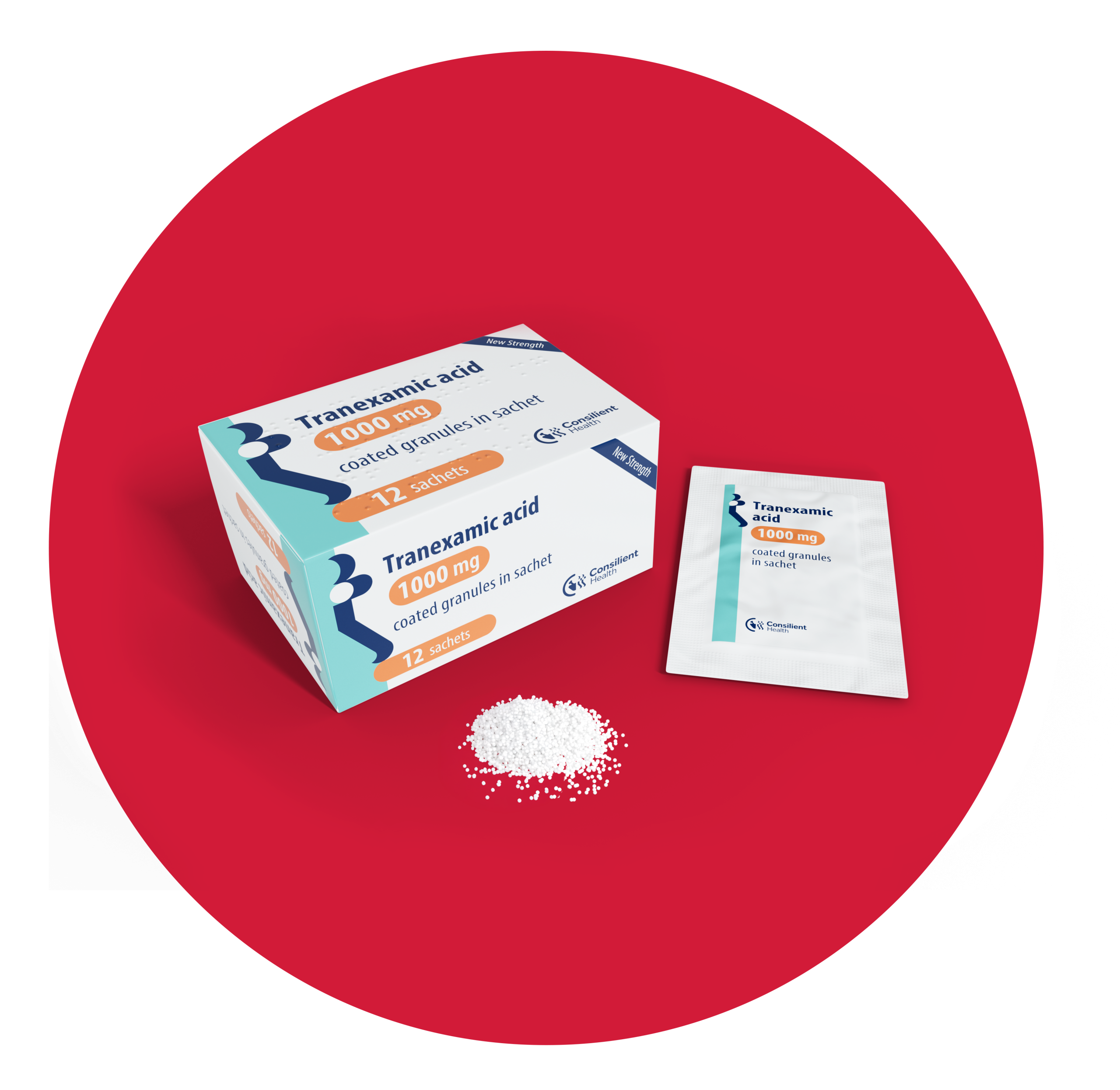
What are Tranexamic Acid Coated Granules?¹
Tranexamic Acid 1000 mg Coated Granules in sachet contain tranexamic acid, which is used for heavy menstrual bleeding (HMB) or menorrhagia. Tranexamic acid reduces bleeding by preventing the enzyme which dissolves blood clots to act. This causes less blood loss and a quicker cure rate. Tranexamic acid should only be used when your periods are regular and you are 15 years old and above.
How to take Tranexamic Acid Coated Granules¹
Always take this medicine exactly as described in this leaflet or as your doctor or pharmacist has told you. Check with your pharmacist if you are not sure.
Coated granules should be swallowed straight from the sachet and can be washed down with a glass of water.
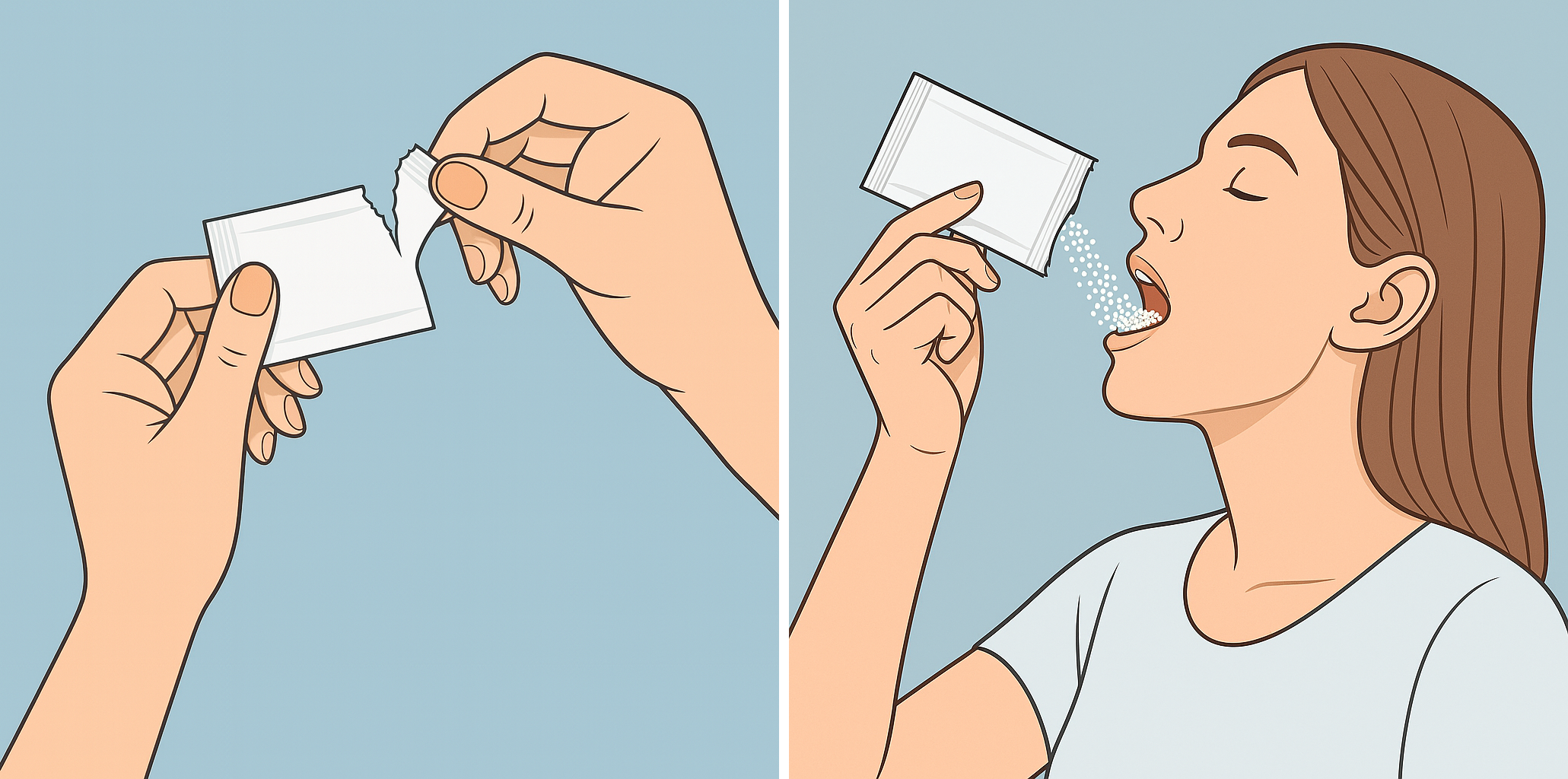
Treatment should start when your period has started. The recommended dose for adults and adolescents from 15 years is 1 sachet 3 times daily as long as needed, for a maximum of 4 days. The dosage can be increased to a maximum of 4 sachets per day (1 sachet every 6 to 8 hours), if bleeding remains heavy after starting treatment. Your doctor may prescribe a different dose. See your doctor if you do not respond to treatment with tranexamic acid.
If you take more tranexamic acid than you should
If you have taken more tranexamic acid than you should, or if children have been taking medicine by accident, contact your doctor or hospital to get an opinion of the risk and advice on action to be taken. Signs of an overdose may include dizziness, headache, nausea, diarrhoea, low blood pressure, myopathy and convulsions. It may include increased risk of thrombosis if you are predisposed.
If you forget to take tranexamic acid
Do not take a double dose to make up for a forgotten dose.
What you need to know before taking Tranexamic Acid Coated Granules¹
Please note that tranexamic acid should only be used if your periods are regular and heavy. To be sure, you should answer yes to both the following questions:
1. Are your periods regular, i.e. your menstrual cycle is between 21 to 35 days long?
2. Do you need to use double sanitary protection, towels plus tampons or double towels to prevent bleeding through, alternatively change sanitary protection very often?
- If you are treated for blood clot e.g. in legs, lungs or brain
- If you have severe reduced kidney function
- If you have a history of convulsions (seizures or fits)
- If you are taking a combined hormonal contraceptive (“the pill”, vaginal ring or patch)
- If you are allergic to tranexamic acid or any of the other ingredients of this medicine
The other ingredients are: Sugar spheres (sucrose, maizestarch), Povidone K30 (E1201), Sucralose (E955), Silica colloidal anhydrous (E551), Polyacrylate dispersion 30 per cent, Talc (E553B)
Talk to your doctor before taking tranexamic acid if you have any of the followings:
- Your periods are irregular
- You have ever had a blood clot and your parents and/or brothers or sisters have had a blood clot
- You have had blood in your urine in between your periods
- You have reduced kidney function.
If heavy bleeding occurs during use of combined hormonal contraceptives (“the pill”, vaginal ring or patch), you should not start tranexamic acid, but consult your Healthcare professional.
Heavy menstrual bleedings can occur due to diseases in the womb such as myoma or polyps. If they are taken care of, the heavy menstrual bleeding decreases. If anything is unclear, you should ask your gynaecologist.
Continued gynaecological health controls are recommended.
Children and adolescents
Clinical experience with tranexamic acid in menorrhagic children under 15 years of age is not available.
Other medicines and tranexamic acid
Tell your doctor or pharmacist if you are taking, have recently taken or might take any other medicines. If tranexamic acid is taken at the same time as anticoagulants, it could potentially affect the way that Tranexamic acid or the anticoagulants work.
Pregnancy and breast-feeding
Tranexamic acid is indicated for regular heavy menstrual bleedings and is not intended for use during pregnancy. Impact of breastfeeding for the child seems unlikely at therapeutic doses. Ask your doctor or pharmacist for advice if you are breastfeeding.
Driving and using machines
Side effects that can affect the ability to drive and use machines have been reported. If you feel dizzy or have problems with your eyesight you should not drive or use machines until the symptoms have passed.
Tranexamic Acid 1000 mg Coated Granules in sachet
Contains sucrose. If you have been told by your doctor that you have an intolerance to some sugars, contact your doctor before taking this medicinal product.
Like all medicines, this medicine can cause side effects, although not everybody gets them.
Common (may affect up to 1 in 10 patients): Nausea, vomiting, diarrhoea, stomach pain,headache, dizziness. These side effects are often mild and transient.
Uncommon (may affect up to 1 in 100 patients): Allergic skin reactions.
Not known (frequency cannot be estimated from the available data): Rare cases of blood clots, changes in colour vision and other problems with the eyesight, convulsions.
If tranexamic acid does not have sufficient effect or if you do not tolerate tranexamic acid, there are other methods to treat heavy menstrual bleedings. Contact your gynaecologist who can give information about those methods.
Reporting of side effects.
If you develop any side effects (adverse events) while taking a Consilient Health medicine, please talk to your doctor, pharmacist, or nurse.
This includes any possible side effects not listed in the package leaflet.You can also report side effects directly via the Yellow Card Scheme at https://yellowcard.mhra.
By reporting side effects you help provide more information on the safety of our medicines.
References:
1. Consilient Health (2025). Patient Information Leaflet. [online] Available at: https://www.consilienthealth.co.uk//wp-content/uploads/2025/10/06_P1687_

Copyrights © 2025 All Rights Reserved by Consilient Health Ltd
UK-GEN-207 November 2025